Better pray the number crunchers didn’t make a mistake with their mathematics. If they did you can stick your head between your legs and kiss your ass goodbye.
C/2022 E3 (ZTF) is a long-period comet that was discovered by the Zwicky Transient Facility on 2 March 2022. The comet will reach its perihelion on January 12, 2023, at a distance of 1.11 AU (166 million km) and the closest approach to Earth will be on February 1, 2023, at a distance of 0.28 AU (42 million km). The comet is expected to get brighter than magnitude 6 and thus become visible with the naked eye.
Continue Reading → Wikipedia
Close Approach Data The following table shows close approaches to planets, the moon, and the largest few main-belt asteroids (such as 1 Ceres, 4 Vesta, and 10 Hygiea). Only close approaches with reasonably low uncertainty are included. A merged table of close approaches to Earth by all NEOs is available on the CNEOS.
Continue Reading → Website.
Small-Body Database Lookup. Continue Reading → Website.
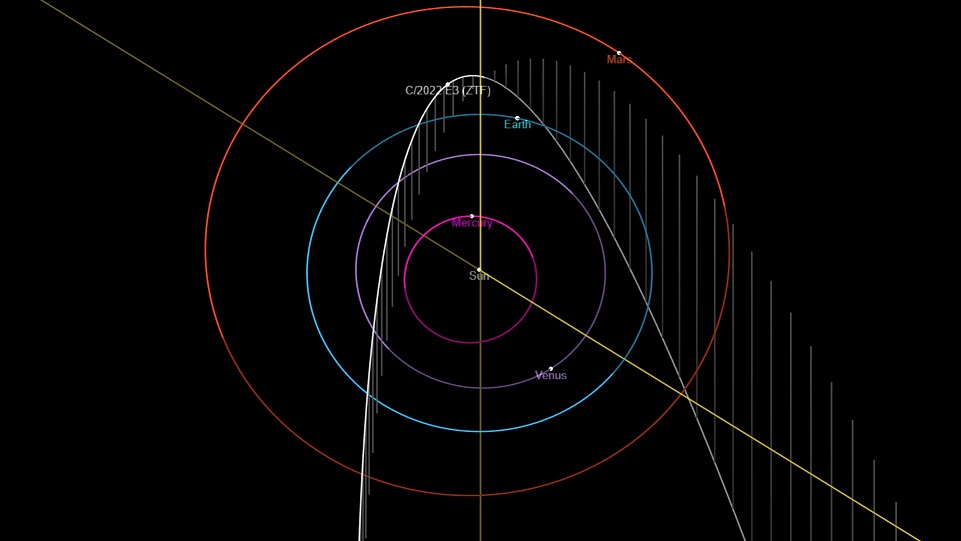
C/2022 E3 (ZTF)
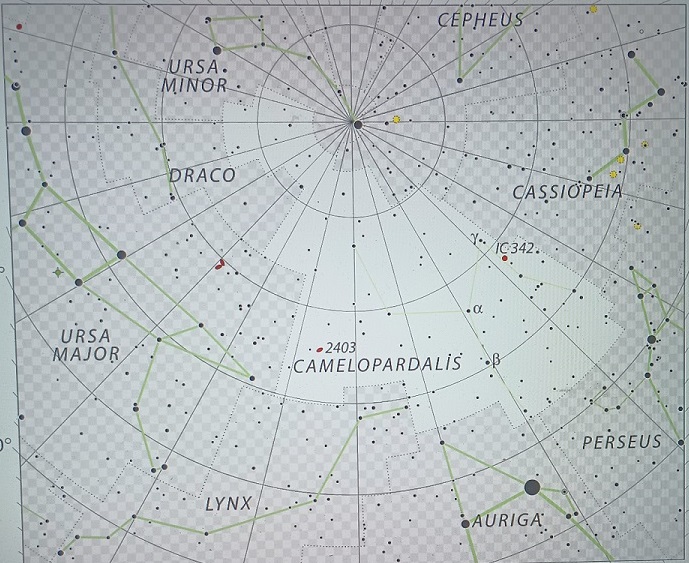
The comet will reach its perihelion on January 12, 2023, at a distance of 166 million km and the closest approach to Earth will be on February 1, 2023, at a distance of 42 million km. The comet is expected to get brighter than magnitude 6 and thus become visible with the naked eye from a dark sky site, appearing as a smudge in the sky. During its closest approach to Earth, it will appear near the north celestial pole and be located within the Camelopardalis constellation. On February 10-11 the comet will pass 1.5 degrees from Mars and on February 13 to 15 will pass in front of Hyades star cluster.
Camelopardalis
Camelopardalis is a large but faint constellation of the northern sky representing a giraffe. The constellation was introduced in 1612 or 1613 by Petrus Plancius. Some older astronomy books give Camelopardalus or Camelopardus as alternative forms of the name, but the version recognized by the International Astronomical Union matches the genitive form, seen suffixed to most of its key stars.