
In Three Years
This Star Explosion Will Be Seen From The Earth in 2022 – 2023
This Terrifying Star Explosion Will Be Seen in the Sky. → Click here
Posted in Stars
Comments Off on In Three Years
Great Attractor
Panoramic view of the entire near-infrared sky. The location of the Great Attractor is shown following the long blue arrow at the bottom right.
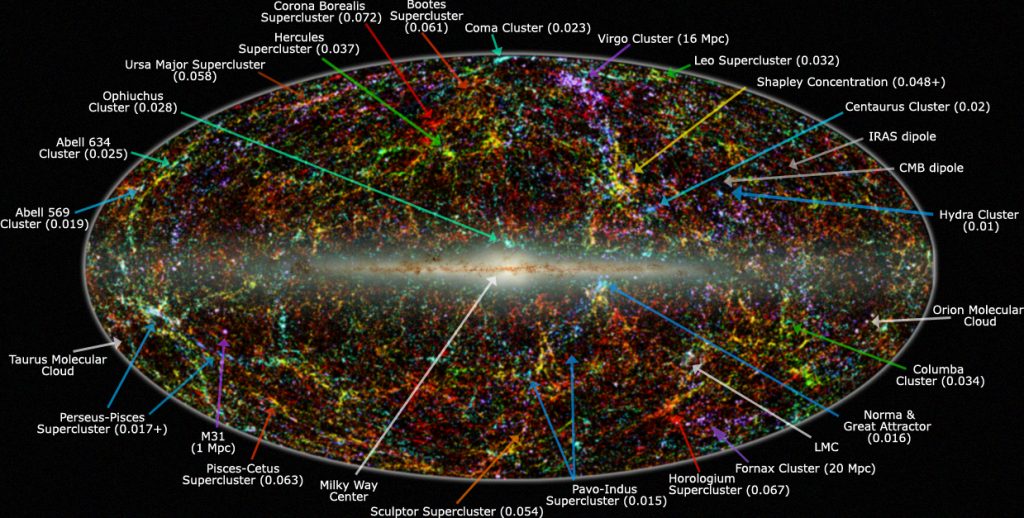
The Great Attractor is a gravitational anomaly in intergalactic space and the apparent central gravitational point of the Laniakea Supercluster. The observed anomalies suggest a localized concentration of mass millions of times more massive than the Milky Way. However, it is inconveniently obscured by our own Milky Way’s galactic plane, lying behind the Zone of Avoidance (ZOA), so that in visible light wavelengths, the Great Attractor is difficult to observe directly. In fact, it will not be for another hundred million years that Earth will be on the other side of the Milky Way galaxy, allowing us to see past the galactic plane.
The anomaly is observable by its effect on the motion of galaxies and their associated clusters over a region of hundreds of millions of light-years across the universe. These galaxies are observable above and below the ZOA; all are redshifted in accordance with the Hubble flow, indicating that they are receding relative to us and to each other, but the variations in their redshifts are large enough and regular enough to reveal that they are slightly drawn towards the anomaly. The variations in their redshifts are known as peculiar velocities and cover a range from about +700 km/s to −700 km/s, depending on the angular deviation from the direction to the Great Attractor.
The Great Attractor itself is moving towards the Shapley Supercluster. Recent astronomical studies by a team of South African astrophysicists revealed a supercluster of galaxies, termed the Vela Supercluster, in the Great Attractor’s theorized location.
Great Attractor → Wikipedia
Posted in Universe
Comments Off on Great Attractor
Memphis Astronomical Society
Memphis Astronomical Society → Website
Finding Celestial Objects. The use of sky maps in finding and learning the major constellations and locating important celestial objects. Also covers how to use your telescope to find the Sun, Moon, and planets, naked-eye stars and deep-sky objects, and a few other interesting objects which are located near easily-found stars.
Posted in Beginners, University
Comments Off on Memphis Astronomical Society
Blog
Water Cooler
Hang Out… Around The Water Cooler.
An Area Just To Hang Out…Crack Some Jokes…Tell Some Stories.
An Area To Talk About Pretty Much Anything.
Get Acquainted With Other Members…
Warning: Sailor Talk Ahoy!
There are three kinds of people who view my Blogs: Those who like it, those who hate it, and those who simply don’t understand. I am especially interested in this last category. I hope my Blogs will create conversation and reach people on a deeper level. I like to use metaphors and multiple levels of meaning to reach my viewer. If it makes them think and feel, then it is successful.”
Comments Off on Blog